


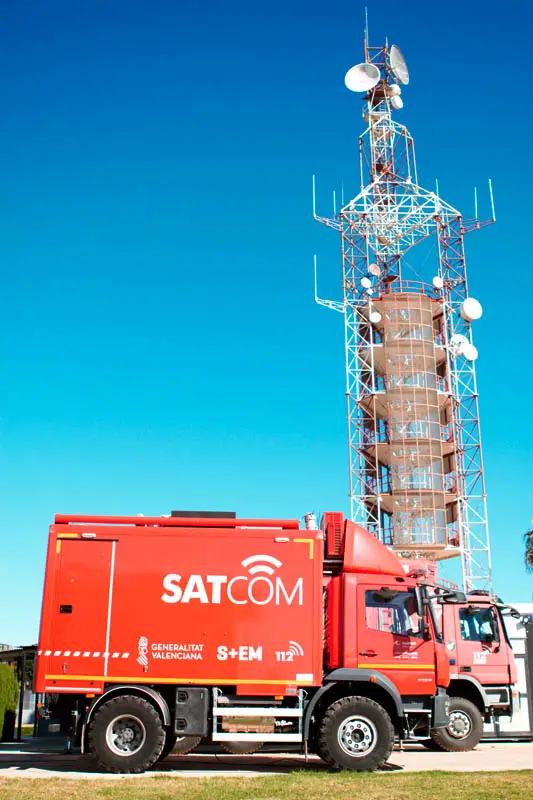
The Generalitat has presented the experimental 5G Emergencies project, whose objective is to test and validate in real-life conditions the potential use of these mobile networks to support emergency management. This will be done through four pilot tests to be carried out in two urban areas, an industrial zone, and a rural environment in the Comunitat Valenciana.
The project is coordinated by Infraestructures i Serveis de Telecomunicacions i Certificació (ISTEC), the public entity attached to Economía y Hacienda that manages the Generalitat’s telecommunications infrastructures and certification services. The initiative stems from a proposal by the Agencia Valenciana de Seguridad y Respuesta a las Emergencias (AVSRE), which operates under the Conselleria de Emergencias e Interior.
iTEAM contributes to the project by providing its well-known expertise in conducting 5G pilots, as explained by David Gómez-Barquero, professor at the UPV and iTEAM researcher: “Since 2019, iTEAM has participated in virtually all 5G pilots carried out in the Comunitat Valenciana, including those with the puerto de Valencia and Ford. On this occasion, we are involved in defining and validating all the technical tests related to 5G technology.”
This is a joint project between the conselleries of Economía, Hacienda y Administración Pública and Emergencias e Interior, presented by their respective heads, José Antonio Rovira and Juan Carlos Valderrama, who noted that it has received €4,069,270 in European Next Generation EU funding through the Plan de Recuperación, Transformación y Resiliencia.
Strengthening communications
Rovira and Valderrama emphasized that the aim of 5G Emergencias is to assess how this technology performs when used to support the current emergency network of the Comunitat Valenciana. The goal is to evaluate its practical performance, identify potential limitations, and determine its real contribution in the event of a potential emergency.
In this regard, both stressed that this is an experimental project and does not in any case replace the current emergency network, which will remain operational using TETRA technology that supports the red de Comunicaciones Móviles Digitales de Emergencias y Seguridad de la Comunitat Valenciana (COMDES).
Juan Carlos Valderrama underlined that the project “is an additional tool that may prove useful in strengthening our response capacity and improving coordination among all teams involved in an emergency.”
“We are thus moving towards a more modern and efficient model, in which information can be shared in real time and support those working on the ground,” stated the conseller de Emergencias.
Four pilot tests
As part of this project, four pilot tests have been scheduled across three different environments to assess functionality in a densely populated urban area; in an industrial zone with large open spaces and large-scale buildings; and in a rural setting with low population density and limited network coverage.
The urban-area tests are scheduled for 22 February in València, coinciding with the Cridà, and on 22 April, during a football match, in order to conduct them at large-scale public events.
During these exercises, which will not cause any disruption to attendees, the aim is to assess how communications behave when a large number of users are connected; whether priority can be guaranteed for emergency services; and whether data and video use is feasible without affecting critical communications.
As the industrial zone with large open spaces and large buildings, the headquarters of a company in Almussafes has been selected. The Consorcio de Bomberos, the Policía Local of the municipality, and the AVSRE will take part.
In this case, based on a simulated industrial accident involving chemical risk that prevents immediate access by human teams to the affected area, the test will assess communication continuity in coverage shadow zones, the use of video and remote control in complex scenarios, and the management of a simulated emergency in an industrial environment.
The next pilot test is scheduled for April in the area surrounding the pantano de Benagéber, in a simulated forest fire scenario. During the exercise, a firefighting aircraft will suffer an accident while collecting water from the reservoir and will be partially submerged.
Personnel from the Sociedad Valenciana de Gestión Integral de los Servicios de Emergencias (SGISE) and the AVSRE will take part in this drill, which aims to evaluate the capacity to deploy communications in areas without mobile coverage, analyze the combined use of 5G and satellite technology to support emergency response, and validate the transmission of video and data from aerial and underwater drones.