


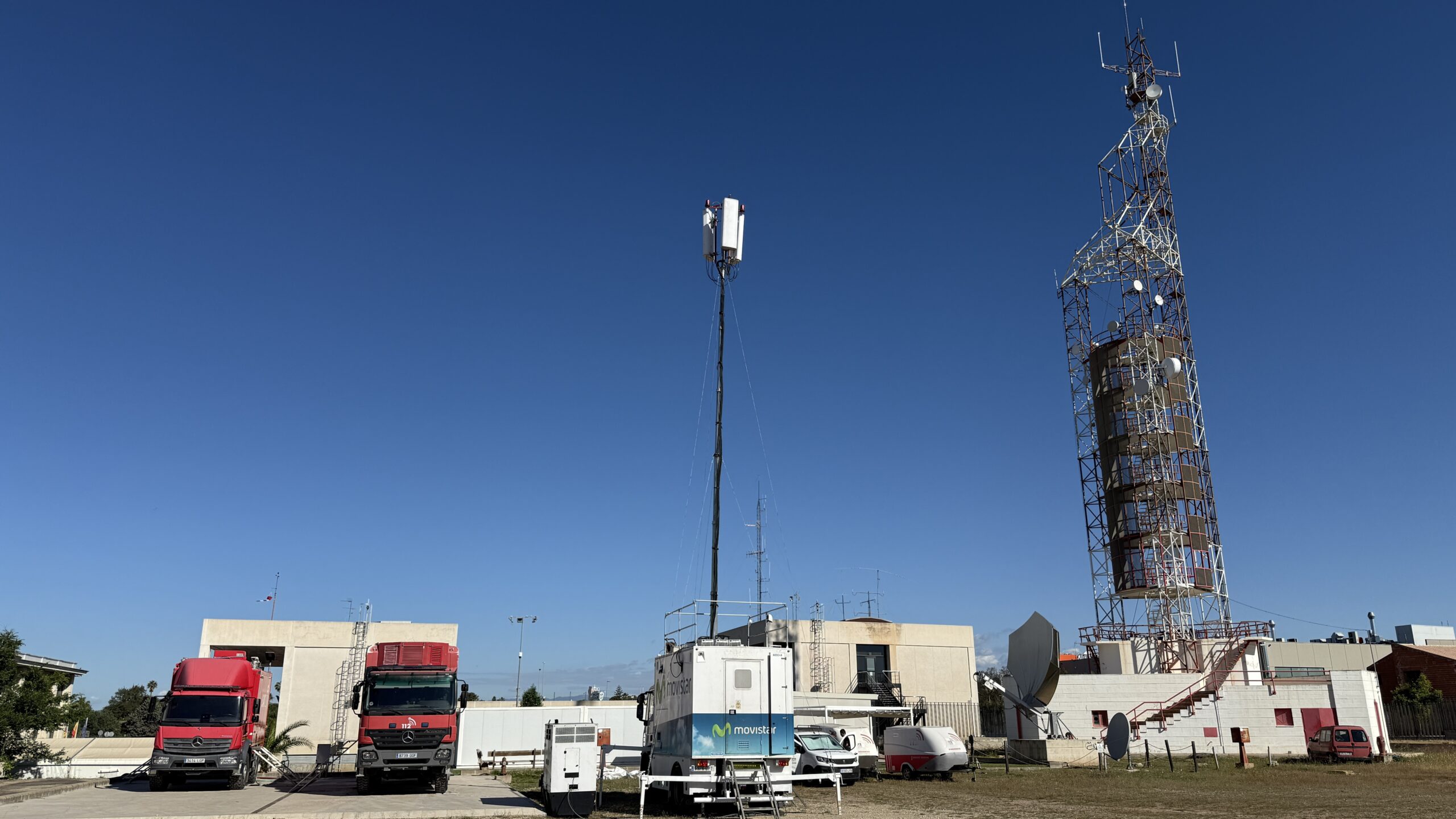
For the first time, interoperability between the regional COMDES network and the national SIRDEE network has been tested.
The 5G Emergencies project has reached a significant milestone with the execution of its fourth pilot test at the Emergency Coordination Center in l’Eliana. This current phase is part of a progressive validation methodology that has explored several critical scenarios: an initial deployment in the high-density environment of Valencia’s Crida festival, a second phase at the industrial complex in Almussafes Industrial Park, and a third evaluation in the natural setting of the Benagéber reservoir. Under the coordination of ISTEC and following the guidelines of the Valencian Agency for Security and Emergency Response, the trial was supervised by authorities from the State Secretariat for Telecommunications, reinforcing institutional support for this cutting-edge infrastructure.
At the technological core of this fourth phase is the deployment of a transportable tactical bubble implemented in a mobile unit. This system enables the creation of a private emergency network operating on dedicated radio spectrum, guaranteeing complete independence from commercial infrastructures. As an additional safeguard, backup capability on the commercial 5G network was also tested through network slicing technology, which ensures communication priority for emergency response teams even in situations of extreme digital traffic congestion, thereby protecting the operational capacity of security personnel.
The main research innovation demonstrated during this exercise was the interoperability between the regional COMDES network and the national SIRDEE network. This integration represents a critical advance in crisis management, as it enables seamless and unified communication among different security forces (including local police, the Guardia Civil, and the National Police) through the convergence of advanced mobile terminals and traditional TETRA or TETRAPOL radio systems. Validation was extended to real-world scenarios through coverage tests in urban and commercial areas of l’Eliana, evaluating signal performance under different building conditions.
During the operations, advanced monitoring devices designed to optimize coordination and tactical tracking were integrated. These technologies included biometric sensors for operational personnel, body cameras with live video transmission to the command center, and high-fidelity critical communications applications. Together, these tools significantly improve real-time decision-making during emergency situations.
This experimental project is coordinated by ISTEC, following a proposal from the Valencian Agency for Security and Emergency Response (AVSRE), under the Regional Ministry of Justice and Interior, in collaboration with the Regional Ministry of Finance, Economy and Public Administration. The project involves the participation of UPV, NAE, and Telefónica. The initiative has a budget exceeding €4 million, financed through the European Union’s Next Generation EU funds under the Recovery, Transformation and Resilience Plan.