


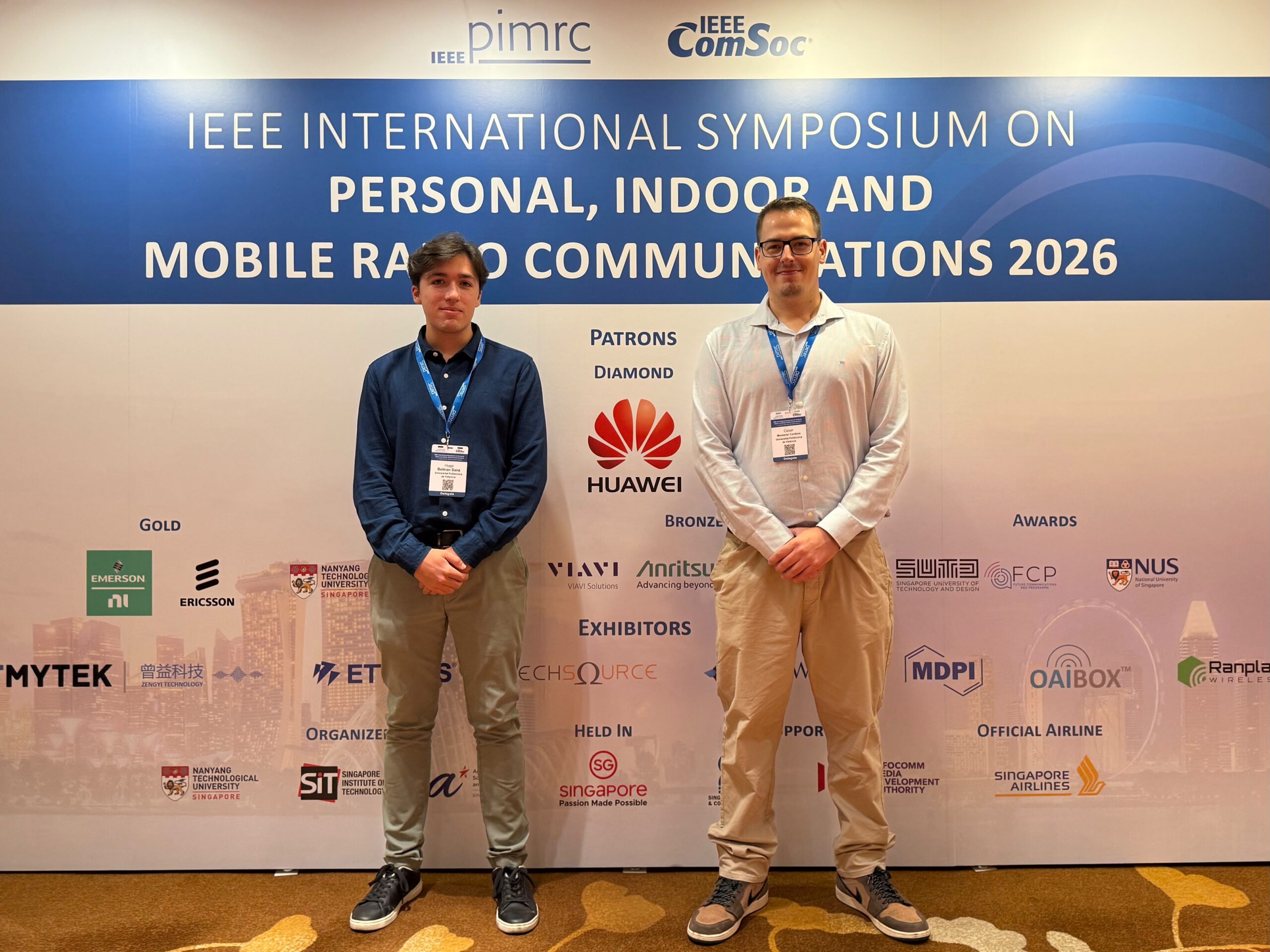
Researchers César Montaner Cardoso and Hugo Beltrán Sanz, from the Mobile Communications Group (MCG) at iTEAM, participated in the IEEE International Symposium on Personal, Indoor and Mobile Radio Communications (PIMRC 2026) in Singapore.
During the conference, both researchers presented two studies focused on the characterisation and modelling of communication channels, proposing approaches aimed at improving simulation fidelity and the estimation of real-world propagation conditions in different environments.
César Montaner presented a study on the validation of RF Digital Twins in the FR3 frequency band, based on directional measurements using a rotating receive antenna in an indoor environment. The work compares deterministic Ray-Tracing (RT) simulations with real measurements through complementary channel metrics, including the Power Delay Profile (PDP), Power Angular Profile, RMS delay spread, and synthetic omnidirectional channel responses.
The results show that the RF Digital Twin can reproduce the dominant multipath components and their angular–temporal behavior, achieving good consistency with the measured channel. The work represents a further step toward the use of RT-based Digital Twins for realistic and site-specific channel modeling in FR3, while highlighting the value of angular measurements for validating both the spatial and temporal characteristics of the simulated radio channel.
Meanwhile, Hugo Beltrán presented a hybrid methodology that combines real channel measurements with RT simulations to interpolate and estimate channel characteristics at points within a scenario where no measurement data are available.
The proposed approach was validated in two different scenarios: an indoor environment using a Virtual Antenna Array (VAA), and an outdoor environment using a rotating antenna. Using metrics such as PDP, RMSE, Normalized Mean Square Error (NMSE), and correlation, the study demonstrates that the methodology can successfully reconstruct the channel by leveraging information from nearby points with real measurements. The results confirm the applicability of this methodology in both indoor and outdoor environments, as well as its compatibility with different measurement techniques, opening up new possibilities for communication channel reconstruction and modelling.