


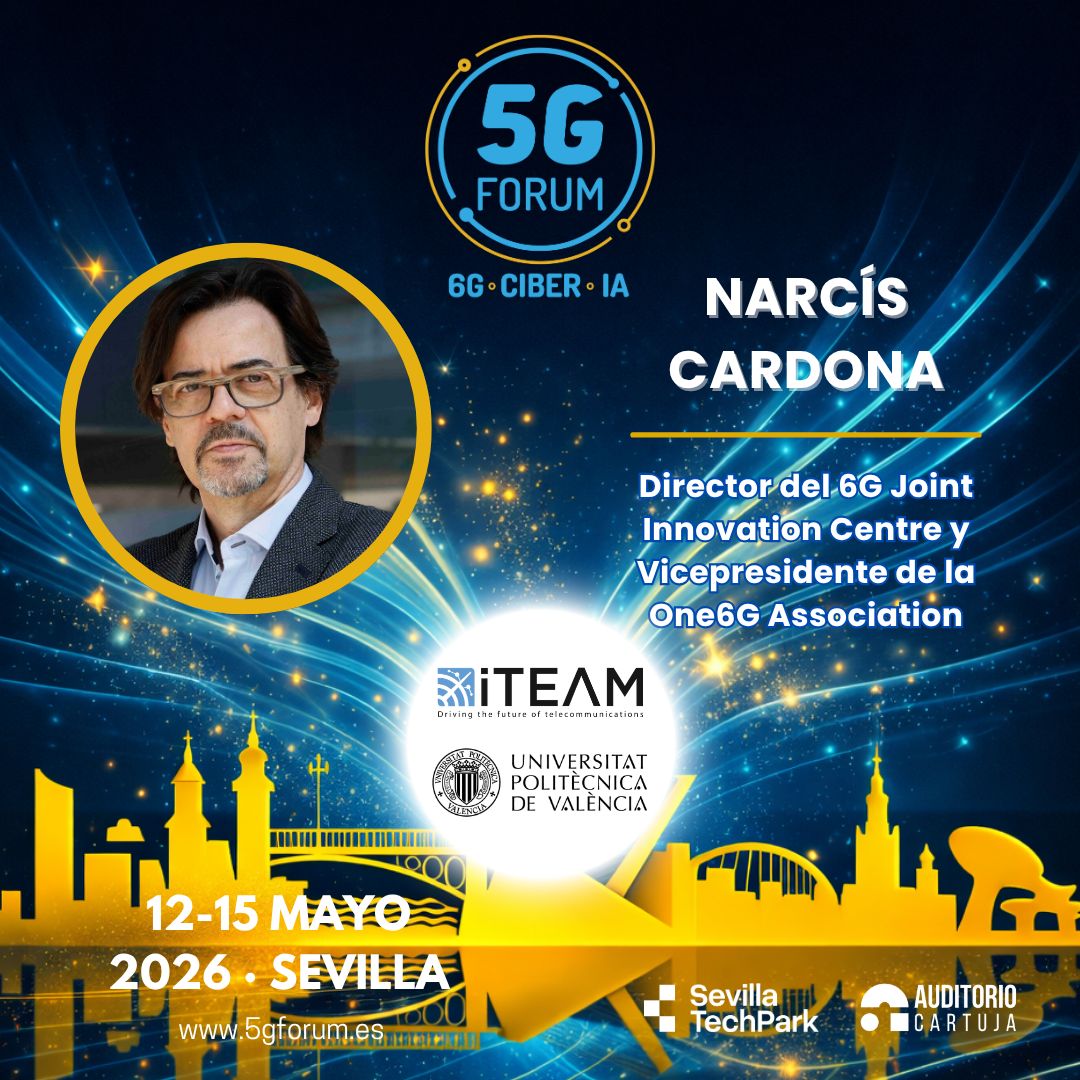
Narcís Cardona, Director of the 6G Joint Innovation Centre and Vice President of the One6G Association, as well as a researcher at the iTEAM Research Institute of the Polytechnic University of Valencia, will offer a strategic vision on the role Spain is playing in shaping this new technology.
- The ninth edition of the 5G Forum will be held in Seville from May 12 to 15 in a hybrid format, with two in-person days at the Cartuja Auditorium (managed by Yventu) at Sevilla TechPark, and two virtual days.
The ninth edition of the 5G Forum – “Where technology leaders meet,” to be held in Seville from May 12 to 15, will focus not only on the evolution of 5G but also on the leap toward the next generation of connectivity. In this context, the event will feature the participation of Narcís Cardona, Director of the 6G Joint Innovation Centre and Vice President of the One6G Association, as well as a researcher at the iTEAM Research Institute of the Polytechnic University of Valencia.
His talk, entitled “Spain at the frontier of 6G technology,” will provide a strategic overview of the role Spain is playing in defining this new technology, at a key moment when 6G is beginning to take shape ahead of its future standardization.
A decisive moment for technological leadership
The development of 6G is currently at a critical stage: still being defined, but with the first steps toward international standardization processes already underway. In this scenario, Spain has managed to position itself as a relevant player thanks to strong public investment, especially through the Next Generation funds and their channeling into programs such as UNICO.
This momentum has enabled the creation of an advanced research and innovation ecosystem, with the deployment of laboratories, testbeds, and experimental platforms working on key technologies such as AI-native networking, integrated sensing and communications (ISAC), extended reality (XR), advanced security, non-terrestrial networks (NTN), and the convergence between optical and wireless networks.
From investment to execution: the 6G challenge in Spain
Beyond the deployment of capabilities, the real challenge now facing the Spanish ecosystem is their effective exploitation. Narcís Cardona will address how the focus must shift toward generating measurable results, transferring technology to the productive sector, and consolidating real use cases that position Spain on the European 6G map.
In this context, IMPACT6G emerges as an initiative created to coordinate public capabilities at the national level and to articulate a joint proposal that strengthens Spain’s presence in Europe. This collaborative approach seeks to maximize the impact of investments made and improve competitiveness in future European programs.
Windows of opportunity in the global landscape
From the international perspective of the One6G Association, the talk will also analyze where the main opportunities for influence in the development of 6G are opening up. In a highly competitive environment, the ability to contribute to standards, lead European pilots, and develop demonstrators will be key to gaining technological relevance.
With the UNICO programs entering their final phase, Spain faces a strategic opportunity: to transform its investment into tangible leadership. To achieve this, coordination among stakeholders, alignment of efforts, and the identification of areas where the country can play a distinctive role within the European ecosystem will be essential.
The 5G Forum, a showcase for the future of connectivity
The participation of Narcís Cardona reinforces the positioning of the 5G Forum as a space not only to analyze the present of telecommunications but also to anticipate the keys to the future. Seville thus consolidates its role as a meeting point to discuss the next steps in connectivity, at a time when 6G is beginning to take shape and define the new technological paradigm of the coming decade.
The IMPACT network is composed of i2CAT, Gradiant, the University of Murcia, and iTEAM, and is developed under the project RED2024‑153933‑E, funded by MCIU/AEI (DOI: 10.13039/501100011033).